Unlike traditional linkage methods, Exemplar's Genetic Algorithm Module discovers patterns of genetic material that produce medical affectations. To do this, we developed sophisticated artificial intelligence (AI) algorithms, known as genetic algorithms, to sift through datasets and learn what combinations of polymorphisms are most closely associated with the studied affectation. Exemplar actually learns the genetics of disease by simulating evolutionary biology and evolving genetic models in silico. This allows Exemplar to discern combinations of SNP's that together can characterize a given phenotype.
Exemplar's patent pending genetic algorithms rapidly identify critical genomic regions responsible for disease. Rather than being caused by a single high-risk allele, most diseases are the result of the combined effects of several moderate risk alleles operating under the influence of certain environmental factors. Exemplar was specifically designed to model the sets of moderate risk alleles at work in the disease process. Traditional statistical methods are unable to do this. Moreover, Exemplar can incorporate clinical and environmental data into the analysis so the interplay between genetics and environment can be modeled. This approach to discovery is very effective in the biomedical research setting for a number of important reasons.
Results
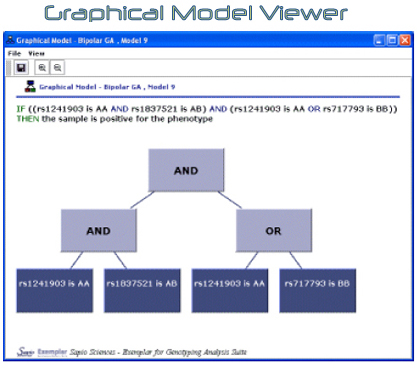
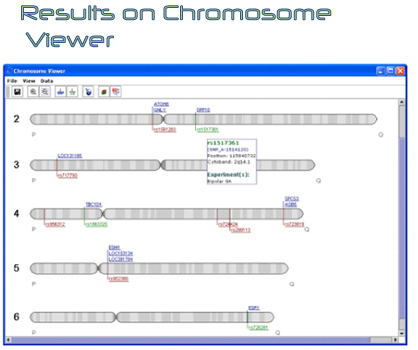
The results of the Genetic Algorithm experiment can be viewed as a graphical multi-locus tree. There is also a prediction table that shows the performance of each model. The SNP's that appear in the multi-locus models can be displayed on the Chromosome Viewer and hovered on to view additional annotations, such as related genes, position, cytoband, alternate SNP ID (if applicable), and the source experiment. |
Hand-model building
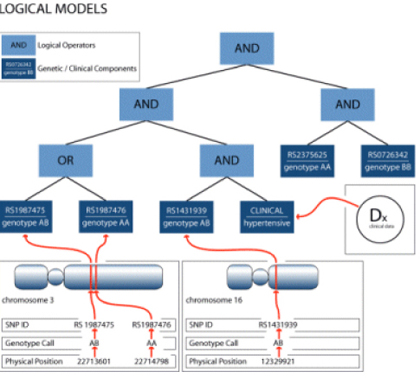
One unique feature about our genetic algorithm approach is that it allows users to perform hypothesis testing on combinations of SNP's and / or clinical data that they feel may potentially characterize the phenotype under study. Researchers have employed this capability to create a model which can then be applied to various sample datasets to test how well it acts as a predictor of those affected versus unaffected in the study. This ability to test multi-locus hypotheses is a very powerful way to investigate possible causes of disease.
Hand-model building is done in Exemplar via a graphical builder tool that allows the user to layout the model and assign values to the nodes of the model.
Validation
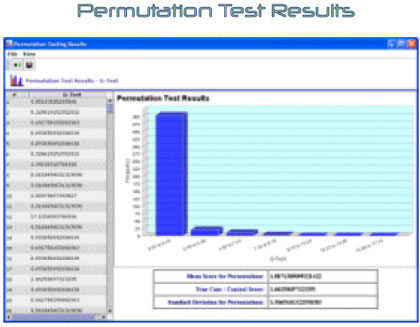
The Genetic Algorithm also includes validation algorithms such as Permutation Testing and Out-of-Sample application of models to determine the effecacy of the model results and characterizing the studied phenotype.
Advantages
Exemplar simplifies experimental design. First, no pedigrees are required for analysis. By eliminating the need for pedigrees, we eliminated a major source of error and it saves valuable research time. Additionally, our AI methods can create informative models from small sample sizes of unrelated individuals. In fact, because Exemplar excels at finding genetic similarities of affected individuals, biological samples can be drawn from a diverse population of people rather than from culturally of physically isolated subgroups. Another benefit of Exemplar is that it allows you the ability to validate your genetic models against out of sample datasets with the click of a mouse button. |